Understanding our Tropical Rainforests
Overview.
In this lesson, we explore what defines a tropical rainforest and examine the unique climate conditions that make jungles both challenging and rewarding environments to guide in. You will learn about the four canopy layers, their significance for local biodiversity, and the typical weather patterns that affect navigation and safety. We will also address common misconceptions people have about jungles—highlighting real versus perceived dangers.
LEARNING OBJECTIVES
Define the key characteristics of tropical rainforests, including temperature, humidity, and rainfall.
Identify the four main layers of the rainforest canopy and understand their ecological significance.
Recognize the difference between perceived “dangerous jungle” myths and actual risk factors.

-
If you're interested, have a look online at different topographical information from around the world:
Resources:
Amazon Rainforest Topographic Map – Provides detailed elevation data of the Amazon basin
Satellite Imagery of the Amazon Rainforest – Highlights environmental changes, deforestation, and terrain features
Live Weather Satellite Data for the Amazon Rainforest – Displays current weather patterns, storms, and rainfall
Amazon Wildlife Distribution Map – Identifies habitats of key species and ecological risk zones
DEFINITION AND CHARACTERISTICS OF TROPICAL RAINFORESTS
• Temperature and Humidity
Jungles typically maintain a year-round average temperature ranging from 20°C to 30°C (68°F to 86°F).
Humidity levels often exceed 80%, creating a perpetually damp environment.
Nights can feel surprisingly cool due to temperature drops, even if the actual temperature remains relatively high.
• High Rainfall
Annual rainfall commonly exceeds 2000 mm (about 80 inches).
Rain can be sporadic yet intense, causing flash floods in mountainous regions.
Wet and dry seasons vary by region; some areas experience shorter dry spells, while others see near-constant precipitation.
• Dense Vegetation
Thick vegetation and undergrowth can limit visibility and slow travel.
Large trees and extensive root systems help anchor the soil in steep or mountainous jungle terrain.
The abundance of plant life supports diverse ecosystems that can change drastically within short distances.
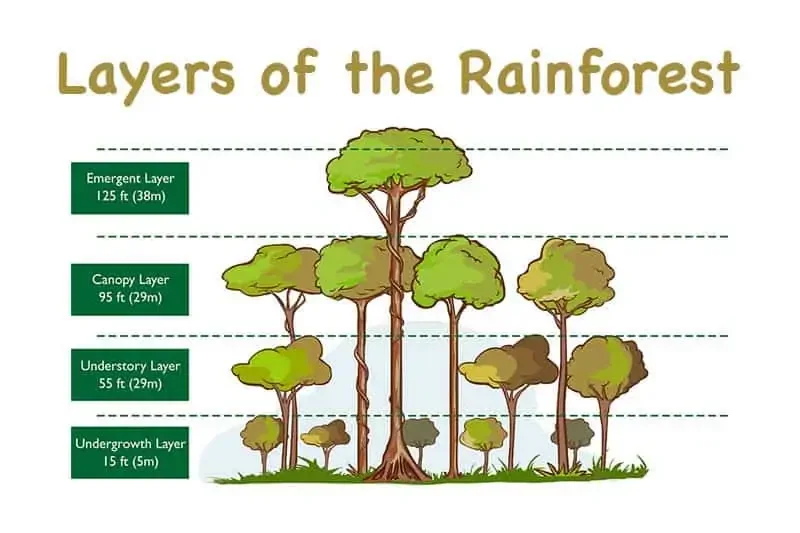
KEY FEATURES: FOUR CANOPY LAYERS
-
Emergent Layer
Tallest trees rising above the general canopy, reaching heights of over 60 meters.
Receives the most sunlight but also faces high wind exposure and temperature fluctuations.
-
Canopy Layer
The main “roof” of the rainforest, formed by the crowns of tall trees.
Houses a large percentage of the rainforest’s biodiversity: birds, insects, monkeys, and countless plant species.
-
Understory Layer
Shaded region beneath the canopy, featuring young trees, shrubs, and climbing plants.
Receives limited light, making it more humid and still, ideal for many insects and reptiles.
-
Forest Floor
Dark and damp, often covered in decomposing plant matter (leaf litter).
Home to fungi, earthworms, and a variety of insects.
Quick decomposition due to high humidity and heat, recycling nutrients back into the ecosystem.
LOCAL WEATHER PATTERNS AND BIODIVERSITY
• Weather Variability
Afternoon storms or downpours are common, triggered by rapid evaporation in humid conditions.
In mountainous jungles, weather can change suddenly, leading to flash floods or sudden cold fronts at higher elevations.
• Biodiversity Hotspots
Rainforests host roughly half of the world’s plant and animal species.
Many species remain unclassified, making rainforest exploration both thrilling and unpredictable.
Knowledge of local wildlife helps guides mitigate dangers such as venomous snakes or aggressive insects.
COMMON MISCONCEPTIONS VS. PRACTICAL REALITIES
• Misconception: “Everything Is Out to Get You”
Reality: While there are venomous creatures and challenging conditions, most wildlife avoids human contact. Basic precautions like wearing protective clothing and being mindful of where you step can significantly reduce risk.
• Misconception: “Jungles Are Impenetrable”
Reality: Many jungles have networks of trails used by locals or animals. Skilled guides also learn machete or cutting techniques to clear paths. Travel is slow but possible with proper planning and pacing.
• Misconception: “It’s Always Rainy”
Reality: While tropical rainforests receive abundant rainfall, many have distinct dry seasons or drier periods. A guide should understand and anticipate seasonal shifts, which greatly impact route selection and logistics.
SUMMARY
This lesson establishes a foundational understanding of what makes a rainforest “tropical” and how its climate and ecological layers shape your approach as a guide. By separating common myths from actual challenges, you can prepare yourself and your clients more effectively for the environment’s real demands.
