The journey of Dr. Amber Carter from marine science to jungle guiding and a different way of seeing conservation. From coral reefs to jungle trails, a scientist finding new ways to understand and protect the natural world.
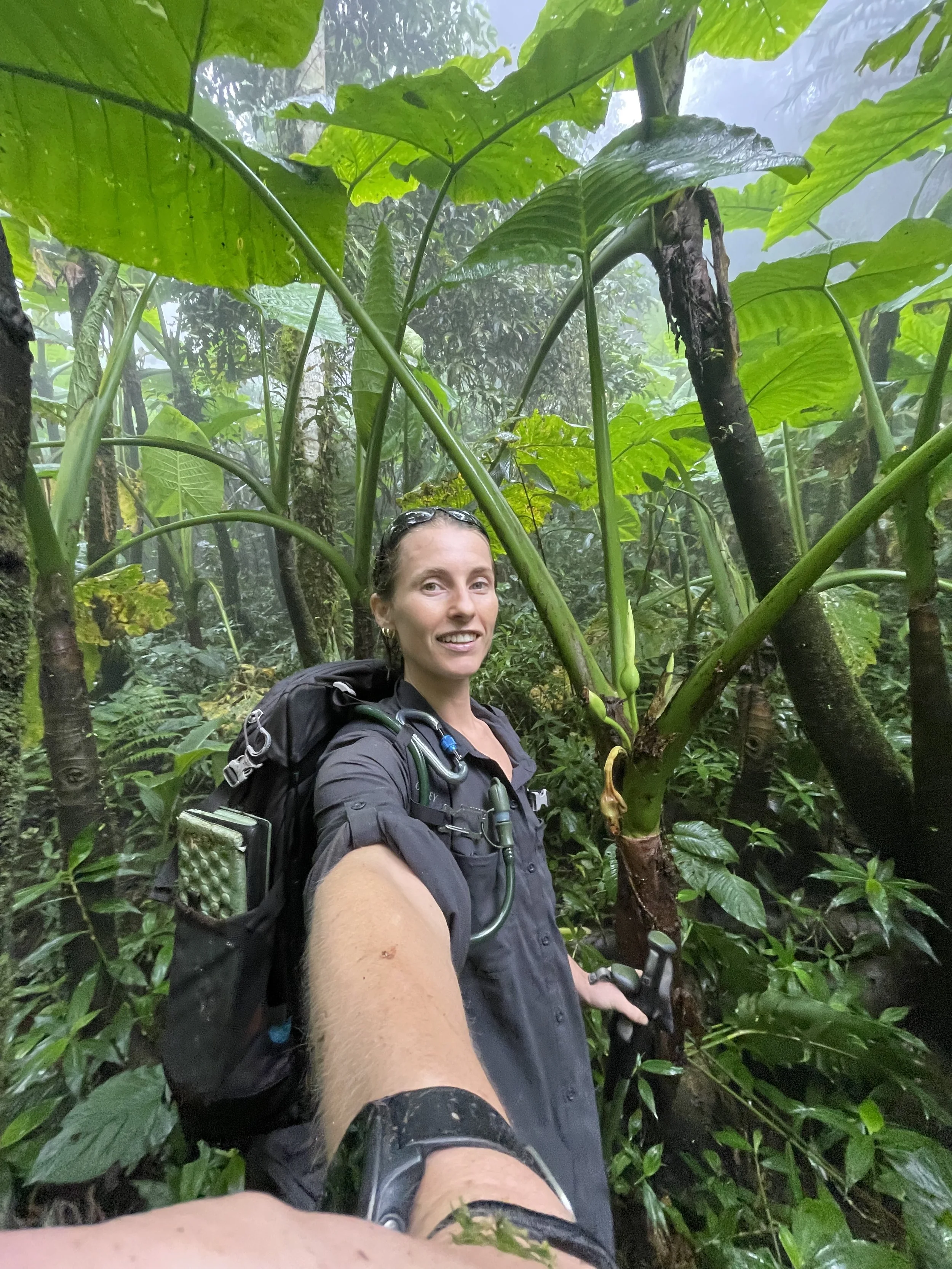
Image: Selfie time in the Panamanian Jungle. Dr. Amber Carter.
Since her earliest memories, Dr. Amber Carter has been drawn towards wild places. Growing up in the United Kingdom, far from the ocean, she spent her childhood seeking out every outdoor adventure she could find. She tried different activities, explored whenever she could and, as a teenager, would joke that one day she wanted to become an explorer.
It was a childhood ambition that might have sounded unrealistic at the time. But in many ways, she never really left it behind. There were different turns along the way, different experiences and different possibilities for a career. Yet whenever she considered what made her happiest, her thoughts kept returning to the same place: nature. “Since my earliest memories, I have always loved the outdoors, loved adventures and exploring nature,” she says. “I tried every outdoor activity I possibly could.”
Eventually, that curiosity would take her from Britain to the tropics, from coral reefs to remote fishing communities, and ultimately into the jungles of Panama. Today, Amber is a marine scientist and researcher at the Smithsonian Tropical Research Institute, where much of her work focuses on the complicated relationship between marine conservation, biodiversity and the communities whose lives depend upon the ocean.
But her story is about more than science. It is also about curiosity, adventure, listening, and learning to see the natural world through perspectives that cannot always be found in a scientific paper.
Finding the tropics
Despite growing up in the UK, Amber always felt an inexplicable connection to tropical environments and the sea. Her childhood travels with her parents introduced her to different cultures and ecosystems, giving her glimpses of a world very different from the one she knew at home. Then, during her undergraduate degree, came the experience that would begin to shape the rest of her life.
She spent a year studying at the University of Miami. Suddenly, the tropics were no longer somewhere she visited. They were somewhere she lived. The ocean was on her doorstep. She could dive on coral reefs, snorkel through mangroves and study marine environments as part of her education.
“I loved living somewhere tropical,” she says. “And even better, I was able to study the coral reefs on my doorstep, diving and snorkelling in the mangroves at weekends. I was living the dream.”
She was twenty years old. And something became clear. “I always knew I would make my way back to the tropics, and I was determined to live and work in the same place.” Panama was already somewhere on her radar. The Smithsonian Tropical Research Institute represented an opportunity to combine scientific research with the tropical environment that had captured her imagination.
When the Institute opened a new centre for social science, Amber saw a potential fit between her interests and the work being done there. “I did everything in my power to make it happen.” Eventually, she did.
You can't be what you can't see
Amber's route into marine science was not something she had always imagined. There was, in fact, a point when she simply didn't know that a career like hers existed. “There’s an old saying, ‘you can’t be what you can’t see,’ and for me that was absolutely true.”
It was at the University of Miami that marine science became tangible. She began taking as many marine science classes as she could and spending time with professors working in the field. She saw people who had built their lives around the things that fascinated her. “Wow, their life seems incredible,” she remembers thinking.
For the first time, becoming a marine scientist didn't feel like an abstract idea. It felt possible. Then came one particular talk. An external speaker who worked for a nonprofit described his work with local fishers to develop marine conservation plans across the Caribbean. He talked about meeting fishers in bars on the beach and spending long periods simply talking with them. Something about the story stayed with Amber. “I don't know why, but something about that moment told me this was what I would do.”
She even wrote about it in a journal that same day, recording her certainty that this was going to become her career. More than ten years later, much of her work is focused on exactly that question: how marine conservation can protect biodiversity while also supporting the people whose food, livelihoods and cultures depend upon the sea. It is a question that sits at the centre of her work in Panama. And it is a question without simple answers.

Image: Coiba National Park. Dr. Amber Carter.
Paradise, with another story underneath
At first glance, Coiba National Park appears almost impossibly beautiful. The waters are rich with marine life. The islands are surrounded by extraordinary biodiversity. For divers and visitors, it can feel like a paradise and has become one of Panama's major attractions.
But Amber's work has taught her to look beyond the surface. Her main research project examines the social outcomes of Coiba National Park for communities living within its buffer zone. Marine conservation has traditionally focused heavily on ecological outcomes: fish populations, habitats, biodiversity and the health of ecosystems.
Those things matter enormously. But there is another side to conservation. When a marine protected area is established, local people can sometimes lose access to fishing grounds that have supported their families for generations. For communities dependent upon the ocean for food, income and culture, those changes can have profound consequences.
Amber is interested in understanding those consequences. “We know far more about the ecological outcomes of marine conservation than we do about the social ones,” she explains.
Her research therefore involves spending time with fishing communities connected to Coiba National Park, listening to their experiences and trying to understand what conservation looks like from their perspective. It has changed the way she sees the park. “What has surprised me most about my work in Panama has been the social justice issues and the complexity surrounding Coiba National Park.”
The contradiction is striking. A place celebrated internationally for its biodiversity and tourism can simultaneously create challenges for people living around it.
Despite Coiba's importance as a tourist destination, Amber believes the park brings relatively little benefit to many of the communities in its buffer zone, while restrictions on fishing can affect access to food and livelihoods. For her, this isn't an argument against conservation. It is an argument for better conservation.

Image: Amber data collecting with local fishermen, Madagascar. Dr Amber Carter.
Listening to people who live with the sea
Perhaps the most important lesson Amber has learned in her work is one that cannot be extracted from a scientific paper. “What have local people taught you that you couldn't have learned from scientific papers?”
Her answer is immediate. “Everything.”
Her research depends upon the support and knowledge of the communities alongside whom she works. There is a reason for that. Scientific knowledge can tell us enormous amounts about an ecosystem. But people who live and work within that ecosystem possess another form of knowledge: observations accumulated over generations, an intimate understanding of seasonal changes, species behaviour, fishing grounds and the rhythms of the ocean.
Amber believes these perspectives need to sit alongside scientific research rather than outside it. “One aim of my research is to understand marine ecosystems through the eyes of the people who live and work beside them.”
That experience has given her a deeper appreciation for what it means to live with the sea. And it has reinforced her belief that conservation cannot simply be something imposed upon communities. The people who depend upon an ecosystem should be part of deciding how that ecosystem is protected.
An ocean that can recover
Despite the challenges, Amber remains optimistic. “What gives me hope is that the ocean can recover, if we simply give it the space to do so.” There are examples around the world of marine ecosystems recovering after fishing pressure has been reduced or destructive practices have stopped.
Sometimes recovery can happen surprisingly quickly. But there is an important qualification. Conservation cannot simply remove people from the equation.
“If this has to be done,” Amber says, “it has to be done with, and ideally led by, the people who live alongside that part of the ocean and depend on it for their livelihood.”
For her, this is the future of marine conservation: not choosing between nature and people, but finding ways for both to thrive. It is also a shift she is excited to see happening within conservation science itself.
She sees growing movement away from a largely extractive, Western model of conservation research towards approaches where scientists work as collaborators and supporters of local communities.
Knowledge is produced together. Local ecosystems are managed together. And communities are given greater control over decisions affecting the environments on which they depend. For Amber, that is not simply a better social model. It is also better conservation.
A life that is part science, part adventure
It would be easy to imagine a scientist's life as one of laboratories, datasets and academic papers. Amber's reality is rather different.
As a researcher at the Smithsonian Tropical Research Institute, no two days are quite the same. She spends much of her time in Panama City, working from the STRI building or, when possible, one of the city's many coffee shops.
She generally has three main projects underway at any one time, meaning that a normal day might involve meetings, reading, planning and organising. Then there is the fieldwork. Around twenty percent of her year is spent working in the field, with the exact nature of that work changing from project to project.
Her current research takes her into communities connected with Coiba National Park, where the most important piece of equipment is often not a scientific instrument. It is the ability to sit down and listen. But there is another side to her work that she particularly enjoys. “I love the adventure.”
She describes her career as “part creative, part data, part adventure.” She organises expeditions, leads teams and travels to places that most people will never see.
It is a career that allows her to combine the curiosity that first drew her towards nature with the scientific discipline needed to understand it. And she never takes that opportunity for granted.

Image: Dr. Amber Carter (right), on our Jungle Skills Course in the Darien Gap, Panama with fellow course mate Jenna Kohles. Dr. Amber Carter.
From the ocean to the jungle
Amber's fascination with wild places isn't limited to the marine environment. The jungle had fascinated her since childhood.
One of the memories that stayed with her was a television programme called Serious Jungle, which followed a group of children trekking through the Amazon. “I wanted to be on that programme so badly!” After moving to Panama, the jungle became increasingly difficult to ignore. But Amber didn't simply want to visit it. She wanted to understand it.
More importantly, she wanted to develop the skills necessary to be comfortable and independent in a remote environment rather than always relying on someone else to guide and support her. That led her to the Jungle Skills course.
“When I found the Jungle Skills course, I couldn't believe my luck. It looked perfect.” What happened during the course surprised her. She expected to be challenged physically and mentally.
What she didn't expect was how quickly learning the right skills would change her relationship with the jungle. “What surprised me was how comfortable I felt in the jungle once I'd learned the skills the course taught.” There is an important distinction here. The course, she explains, wasn't really about survival.
Survival implies an emergency: finding food, making fire and simply staying alive. Instead, the skills gave her something different. “The course isn't about survival in the jungle, that's a very different thing, all about searching for food, making fire, and so on.”
“What it taught instead was how to thrive: how to be comfortable, make sound decisions, and lead others.” That philosophy resonates strongly with the way Amber approaches her scientific fieldwork. Being in a remote environment isn't simply about enduring it. It is about understanding your surroundings, managing risk, making good decisions and being able to contribute to the wellbeing of the people around you.

Image: ‘Team Darien.' Amber, her course mates and instructor in the Darien Gap, Panama while on her Jungle Skills course with Jungle Guides International.
Different environments, shared skills
At first, the connection between marine science and jungle guiding might seem obvious only in the sense that both involve remote environments. For Amber, however, the similarities go deeper.
Much of her professional fieldwork already takes place in remote areas, usually alongside communities and often close to the coast. The jungle course introduced her to an environment that was very different from those she normally works in. But the leadership skills transferred immediately.
Leading groups. Making safe decisions. Remaining composed in challenging conditions. Understanding how decisions affect everyone around you. These are skills that don't belong exclusively to either science or guiding. They belong to working responsibly in remote environments.
There is even one small piece of jungle equipment that has now become a permanent part of her scientific kit. “It's one thing I now always carry with me in the field, alongside my usual kit,” she says. “Paracord!”
Learning to look differently
One unexpected lesson from the jungle course was that being surrounded by nature does not necessarily mean you are able to observe it closely. A jungle expedition is usually a moving experience; you are navigating, managing equipment, watching your surroundings and keeping the group moving, which leaves surprisingly little time to simply stop and look. As Amber puts it, “I realized fairly early on that a jungle expedition isn't really conducive to observing nature.”
Of course, they still encountered incredible wildlife and biodiversity along the way, but it was during the few days they spent in one place, surrounded by people with a deep knowledge of Panama's natural world, that Amber's appreciation for the smaller details began to grow. In particular, she found herself fascinated by birds and by the ability of experienced naturalists to identify species that she might otherwise have walked straight past.
“I was amazed at how they could identify every single one.”
It was another reminder that there are many different ways of knowing the natural world. A scientist may approach an ecosystem with a particular set of questions, while a local fisher may understand it through generations of experience on the water. A jungle guide develops an understanding through movement, weather, tracks, plants and animal behaviour, while an experienced birdwatcher can recognise a species from a single call. None of these perspectives necessarily replaces the others; together, they reveal a much richer picture of the environment.
That appreciation for different perspectives is also central to the way Amber approaches her scientific work.

Image: View from a fishing boat, Panama. Dr. Amber Carter.
Making conservation work for people and nature
Throughout Amber's career, she has become increasingly interested in what happens when we look beyond the ecosystem itself and consider the people who live alongside it. She is deeply passionate about protecting the ocean, but she is equally aware that conservation can create social injustices when the people who depend upon an ecosystem are excluded from decisions about its future.
Her ambition, therefore, is not simply to protect more ocean, but to rethink how that protection happens. “I hope that over the course of my career I can help shift how we think about marine conservation,” she says, “toward an understanding that marine ecosystems can be protected in a way that benefits both the ecosystem itself and the people who live alongside it.”
That philosophy extends well beyond the communities she works with in Panama. For millions of people around the world, the ocean is not a distant wilderness to be protected from human activity; it is a workplace, a source of food, a cultural landscape and an essential part of everyday life. The same can be said of forests, rivers and jungles, where human communities have often developed deep relationships with their environment over generations.
If we want to protect these places successfully, Amber believes we need to understand not only the ecosystems themselves, but also the people who live within them and depend upon them. That requires something that scientists, conservationists and guides all share: curiosity about places we do not yet understand, humility about what we do not know, and above all, a willingness to listen.
In many ways, it brings Amber's journey back to where it began. As a child, she dreamed of becoming an explorer. Today, she explores in a different way, studying ecosystems through science, understanding communities through conversation and experiencing wild places through fieldwork and guiding.
The environments may change, from coral reefs and mangroves to fishing communities and jungle trails, but the underlying motivation remains much the same: to understand the natural world more deeply, and to find better ways for people and nature to thrive alongside one another.
To learn more about Amber, follow here on Instagram @amber_oceans_

